The Younger Dryas
On burnout, collapse, and Natufian Tyra Banks.

Most days I feel like I’ve given up. I stare out the balcony of our new London rental, coffee in hand, the greying waves in my hair disheveled, and think: ‘what is the fucking point?’. I don’t mean this in a broad, existential way, but rather much more pragmatically: what is the point of putting effort towards an end, of having a project, of making a thing? What is the point, frankly, of doing anything?
I feel this deeply and in my body, sometimes for days in a row. Let’s call it “dread.” I feel it in the way I click “mark all as read” when I open my inbox, or binge-watch box sets from the 2010s when I suddenly wake up at 3am. I feel it in the way I need to stop myself from rolling my eyes every time I have another Al Jazeera push notification pop into my phone with the word “bombs” in it. I’m not sure when dread started. If I had to look back, I’d place it somewhere between the end of the pandemic, the start of the genocide, and the normalization of fascism. Big words and blunt terms that I wish I was choosing for shock value, but that are chosen for the sake of precision and accuracy about very real, horrible things that have happened (and continue to happen).
Initially, a couple of years ago, I felt a shift. It was slight at first, but it grew into a slow-burning despair. It felt like the planet was slowly tilting on its axis; as if the Earth itself was moving in retrograde. I felt despair at the world, at these systems we’ve built, at growing inequality, at “science is bad for you” discourse, at fucking war, and at people in general—not specific persons, just “people,” humanity. But even among this despair-going-on-misanthropy, I still cared.
I cared because as a doctor (derogatory), it’s in my nature to care too much and about everything. I cared that things were going the wrong way, that trends were going backwards, and that human rights were under threat. I cared enough to do something about it every day—whether by showing up as a public health doctor, by participating in modernity with a tad of self-awareness, or by being a generally nice human to everyone around me.
And then, a bit over a year ago, something else kicked in. Maybe it was Trump and Musk directly dismantling the systems that underpin global health architecture. A personal hit. Just a theory. Anyway, despair gave way to what can only be described as crude, icky nihilism. Depressed mid-life crisis daddy vibes, but not in the sexy way, more in the “is he ok?” way. One morning, I looked at myself in the mirror, and saw dread looking back at me. I had become one with it.
Sometime in the middle of 2025, I sat in a doctor’s office in Geneva, where I was working for the World Health Organization. I had pulled my back and injured my shoulder from stubbornly overdoing the gym without proper rest or sleep. The doctor asked me thorough questions, assessed my body, and told me I had an impinged shoulder and severe burnout.
“Excuse your mouth?” said the drag queen that invades my inner monologue. As it turns out, my “poor sleep” was actually badly treated insomnia due to chronic work-induced stress. I’ve always used the term burnout very casually, as in “I’ll have a burnout spritz and some Perello olives, s’il te plaît!”, but this was different.
I was off work for two weeks at first, then back for a heroic week when it became clear that I genuinely needed longer. I finally made my health my number one priority, which eventually led me to quit what I once described as my “dream job.” It is an oxymoronic turn of phrase in retrospect: why would anyone in their sane mind dream of labor? Internalized capitalism at its finest.
Last year, in the depth of burnout, I found the Younger Dryas.
The Younger Dryas is a geological period when, roughly 11,000 to 13,000 years ago, the planet got remarkably colder and drier in a matter of decades. Picture this: the last Glacial Age had finally ended after millennia of ice, and massive glaciers in Europe and Asia had retreated to give way to temperate, fertile valleys. Humans had started organizing in complex groups with their own society, culture, and technology. To them, this reality was meaning-rich and profound. And then, the world suddenly changed.
Whether due to an asteroid impact or a sudden collapse of ocean currents similar to the modern Atlantic Meridional Oceanic Circulation (AMOC), the climate shifted and forced life to adapt. This was one of the earliest global “collapse” events. The Natufians in the southern Levant (modern-day Palestine, Lebanon, and Jordan) had to reverse their sedentary lifestyles and return to nomadism. They were people on the verge of developing agriculture, living within a multi-layered cosmology now lost to time, forced back into the cold.
The period is named after the pollen of Dryas octopetala, a flower that only grows in arctic temperatures. This pollen was found in soil corresponding to the Glacial Age, disappearing for a few thousand years as the world warmed, only to make a sudden, 2,000-year comeback during this “refreezing.” In this detail, the flower that returns only when things get cold, I found a beauty so profound that my burnout symptoms took the backseat. I spent hours rotting in bed, escaping into YouTube videos about stone arrowheads, geological strata, and ancient pollen. I also interrupted conversations with friends and colleagues with “can I talk to you about the Neolithic?” and was surprised that they genuinely wanted to hear about it.
How do we make sense of being born at a time of such rapid change? It frankly gives me vertigo. How did humans 12,000 years ago make sense of their own lives? When did they stop contributing to their pension schemes? At what point did the cracks show? When did they look at their settlements, stable for centuries, and say, this does not make sense anymore? Did Natufian Tyra Banks say: “You must immediately go to the house, pack your belongings, and go roam”?
I think the Younger Dryas resonated with me because of how fast the world is moving. It is so strange, and so random, that we are born during this specific disruption. We have externalized intelligence, the largest leap in technology we have ever had, and thousands of years from now, future humans (if they are still here) will look back at this moment and ask: how did that happen?
Thinking about the Younger Dryas gives me hope, in the sense that it represents the end of one world and the opportunity of starting another. It’s not a “things will get better” kind of hope, but more of a “if you zoom out enough, at a geological scale, collapse is inconsequential and finite”. Strangely, the idea of all life existing in between cycles of collapse and reconstruction pairs well with my burnout spritz. Still, not the kind of hope that helps me get out of bed or edit my CV, but the kind that suggests that we can find meaning in the everyday.
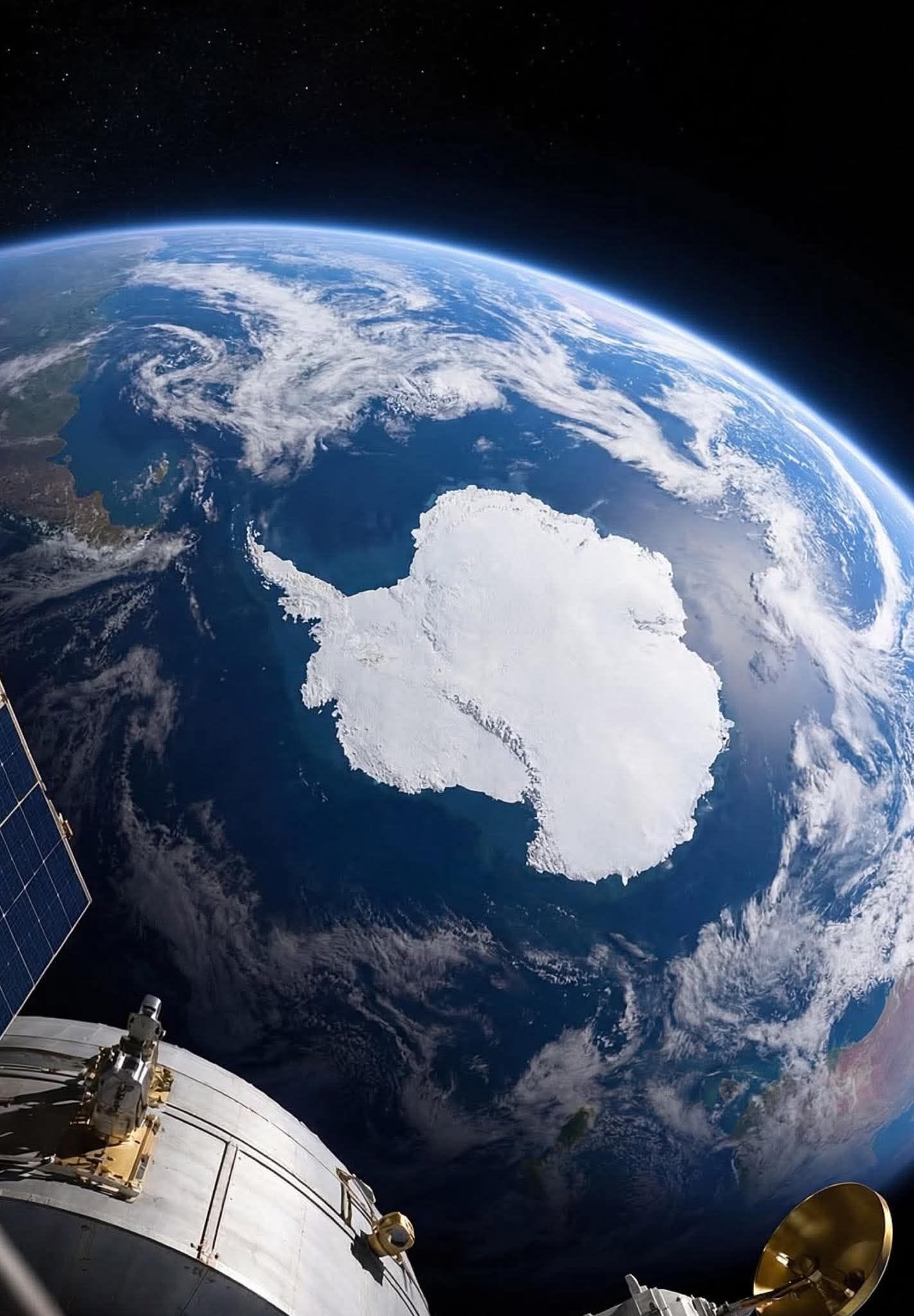
For weeks I have been taking morning walks along the Lea River canal and into the Walthamstow Wetlands, looking for hidden signs of hope: the red flash of a woodpecker banging on a tree, or the sight of a heron—until I stumble into a manic goose. As I walked next to the houseboats earlier this week, I listened to RAYE’s new album. In “Life Boat” she repeatedly chants that she’s not given up yet, and I thought, “Good for you, girl. I do feel like I have.” I took a break sitting on a sunny bench and opened the endless stream of social media posts on my phone. In between all the AI slop, I came across a photo taken from space by the Artemis II crew, and it consumed me: Antarctica photographed as a mass of continental ice, observed by a handful of humans from the outside. The Orion spacecraft, its polygonal solar panels open like flower petals, not pollen but dust. Then I looked at the source. It was AI-generated. And although my heart sunk, it gave me a crystallised revelation: this time, I think we are the asteroid.